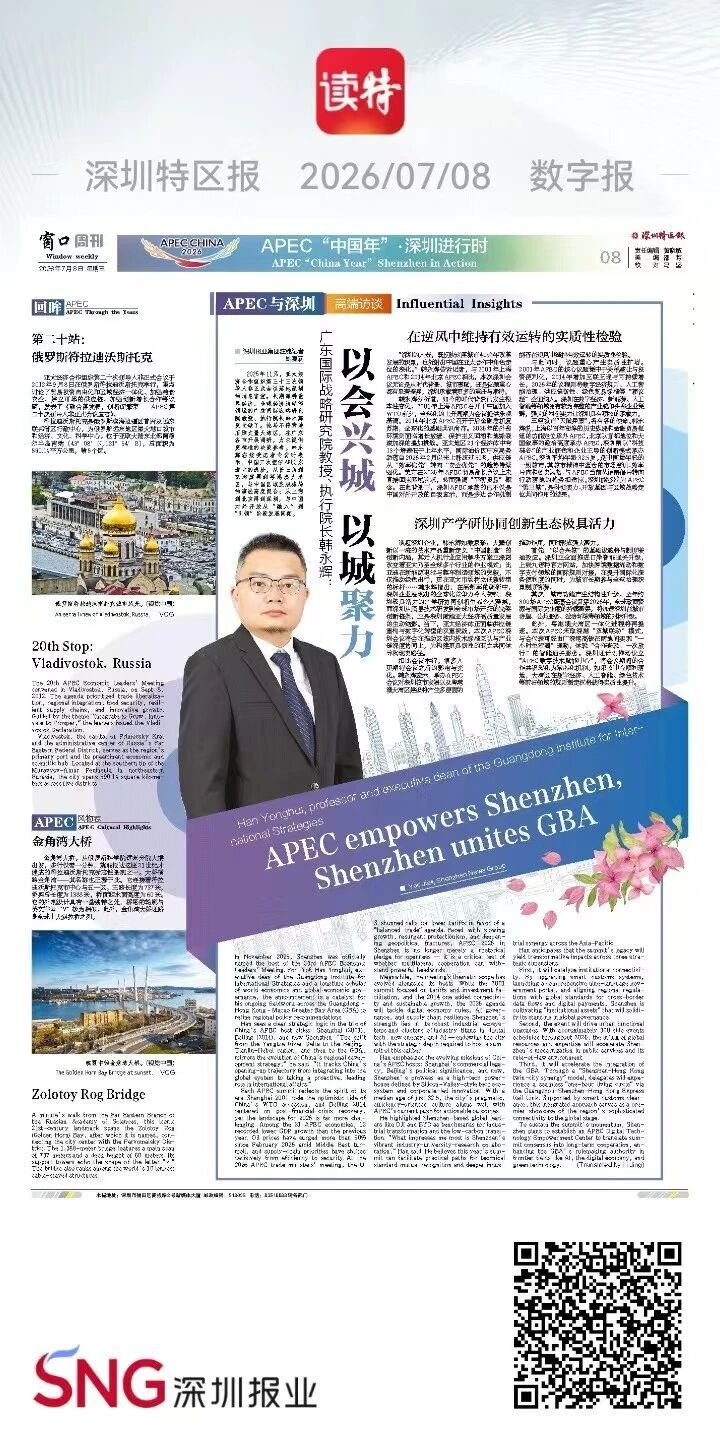
2025年11月,亚太经济合作组织第三十三次领导人非正式会议落地深圳的消息官宣。就此,我院执行院长韩永辉教授受邀在《深圳特区报》发表了相关评论。
韩永辉教授表示,深圳的入选既反映这座城市40余年改革发展的积累,也折射出中国在亚太合作中角色定位的深化。深圳能够成为APEC“第三城”,是科创实力、开放基因与区域战略定位共同作用的结果。
以会兴城 以城聚力
■ 深圳报业集团驻穗记者 姚嘉莉
2025年11月,亚太经济合作组织第三十三次领导人非正式会议落地深圳的消息官宣。长期深耕世界经济、全球经济治理等领域的广东国际战略研究院教授、执行院长韩永辉更忙碌了。他马不停蹄地用脚丈量大湾区,在广东各市开展调研,力求提供更精准的决策参考。韩永辉在接受记者专访时表示,中国三次担任APEC东道主的选址,从长三角到京津冀再到粤港澳大湾区,与中国区域发展格局的演进高度契合;从上海到北京再到深圳,与中国对外开放从“融入”到“引领”阶段发展同频。
在逆风中维持有效运转的实质性检验
“深圳的入选,既反映这座城市40余年改革发展的积累,也折射出中国在亚太合作中角色定位的深化。”韩永辉告诉记者,与2001年上海APEC和2014年北京APEC相比,本次深圳会议无论是从时代背景、城市禀赋,还是议题重心都有显著差异,深圳承载着更多的重任与期待。
韩永辉分析道,如今的时代背景已发生根本性变化。2001年上海APEC召开于中国加入WTO前夕,全球化的上升周期为会议提供乐观基调。2014年北京APEC召开于后金融危机复苏期,全球化的基础共识尚存。2026年的外部环境则面临增长放缓、保护主义回潮和地缘裂痕加深的叠加挑战。亚太地区21个经济体中有13个增速低于上年水平,国际油价因中东局势动荡自2026年2月以来上涨超过50%,供应链从“效率优先”转向“安全优先”的趋势持续强化。美方在2026年APEC贸易部长会议上未直接回应降税诉求,转而强调“平衡贸易”概念。在此背景下,深圳APEC承载的已不仅是中国对外开放的自我宣示,而是多边合作机制能否在逆风中维持有效运转的实质性检验。
与此同时,议题重心产生实质性扩容。2001年APEC的核心议题集中于关税减让与投资便利化,2014年增加互联互通与可持续增长,2026年的议程则将数字经济规则、人工智能治理、供应链韧性、绿色贸易标准等“硬议题”全面纳入。深圳在数字经济、新能源、人工智能等领域拥有较为完整的产业链和头部企业集群,强大的科创实力让深圳具有硬核的承载力。
三座城市“天赋异禀”,各有各的使命。韩永辉说,上海以百年商埠的历史纵深和金融贸易枢纽的功能定位承办APEC,北京以首都地位和大国叙事的政治高度承办APEC,深圳则以“科技硅谷”的产业底色和企业主导的创新模式承办APEC。深圳平均年龄32.5岁,是中国最年轻的一线城市,其城市精神中蕴含的市场意识、效率导向和务实风格,与APEC当前从原则倡导转向行动落地的趋势相适应。深圳能够成为APEC“第三城”,是科创实力、开放基因与区域战略定位共同作用的结果。
深圳产学研协同创新生态极具活力
谈起深圳企业,韩永辉如数家珍:大疆创新以一流的技术产品重新定义“中国制造”的创新内涵,其无人机行业应用解决方案正深刻改变着亚太乃至全球多个行业的作业模式;比亚迪在新能源电池与整车制造领域的突破,不仅推动绿色出行,更在亚太市场树立低碳转型的标杆……韩永辉指出,在高频率的调研中,深圳企业展现出的全球化竞争力令人赞叹,深圳极具活力的产学研协同创新生态令人震撼,而深圳从底层技术研发到全球市场开拓的完整创新链条,正是深圳赋能亚太经济高质量发展的生动缩影。当下,亚太经济体正面临供应链重构与数字化转型的双重挑战,本次APEC深圳会议将会在推动区域内技术标准互认与产业链深度协同上,为构建更具韧性的亚太共同体寻找现实路径。
相比会议举行,很多人更期待会议之后的影响与变化。韩永辉表示,举办APEC会议对深圳城市发展以及粤港澳大湾区建设将产生多层面的推动作用,同时形成强大聚力。
首先,“以会兴城”的基础设施将与制度联通效应。深圳正全面推进口岸智能通关升级,上线九语种官方网站,加快跨境数据流动和数字支付领域的国际规则对接,在提升国际化服务便利度的同时,为城市长期参与全球治理积累制度资源。
其次,城市功能产生结构性升级。全年约300场APEC配套会议贯穿2026年,全球政商资源与国际关注度的持续聚集,将加速深圳在城市治理、公共服务、法治环境等领域的对标升级。
此外,粤港澳大湾区一体化进程将再提速。本次APEC采取深港“双城联动”模式,与会代表可经由广深港高铁在两地间实现“一小时生活圈”通勤,体验“合作查验、一次放行”的智能通关服务。深圳还计划推动设立“APEC数字技术赋能中心”,将会议期间的合作共识转化为常态化机制。如果该中心顺利落地,大湾区在数字经济、人工智能、绿色技术等前沿领域的规则制定权将获得实质性提升。
Han Yonghui, professor and executive dean of the Guangdong Institute for International Strategies
APEC empowers Shenzhen, Shenzhen unites GBA
■ Yao Jiali, Shenzhen News Group
In November 2025, Shenzhen was officially named the host of the 33rd APEC Economic Leaders’ Meeting. For Prof. Han Yonghui, executive dean of the Guangdong Institute for International Strategies and a longtime scholar of world economics and global economic governance, the announcement is a catalyst for his ongoing fieldwork across the Guangdong–Hong Kong–Macao Greater Bay Area (GBA) to refine regional policy recommendations.
Han sees a clear strategic logic in the trio of China’s APEC host cities: Shanghai (2001), Beijing (2014), and now Shenzhen. “The shift from the Yangtze River Delta to the BeijingTianjin-Hebei region, and then to the GBA, mirrors the evolution of China’s regional development strategy,” he said. “It tracks China’s opening-up trajectory from integrating into the global system to taking a proactive, leading role in international affairs.”
Each APEC summit reflects the spirit of its era. Shanghai 2001 rode the optimistic tide of China’s WTO accession, and Beijing 2014 centered on post-financial-crisis recovery, yet the landscape for 2026 is far more challenging. Among the 21 APEC economies, 13 recorded lower GDP growth than the previous year. Oil prices have surged more than 50% since February 2026 amid Middle East turmoil, and supply-chain priorities have shifted decisively from efficiency to security. At the 2026 APEC trade ministers’ meeting, the U.S. shunned calls for lower tariffs in favor of a “balanced trade” agenda. Faced with slowing growth, resurgent protectionism, and deepening geopolitical fractures, APEC 2026 in Shenzhen is no longer merely a rhetorical pledge for openness — it is a critical test of whether multilateral cooperation can withstand powerful headwinds.
Meanwhile, the meeting's thematic scope has evolved alongside its hosts. While the 2001 summit focused on tariffs and investment facilitation, and the 2014 one added connectivity and sustainable growth, the 2026 agenda will tackle digital economy rules, AI governance, and supply chain resilience. Shenzhen’s strength lies in its robust industrial ecosystems and clusters of industry titans in digital tech, new energy, and AI — endowing the city with the strategic depth required to host a summit of this caliber.
Han emphasized the evolving missions of China’s APEC hosts: Shanghai’s commercial legacy, Beijing’s political significance, and now, Shenzhen’s prowess as a high-tech powerhouse defined by Silicon-Valley-style tech ecosystem and corporate-led innovation. With a median age of just 32.5, the city’s pragmatic, efficiency-oriented culture aligns well with APEC’s current push for actionable outcomes.
He highlighted Shenzhen-based global leaders like DJI and BYD as benchmarks for industrial transformation and the low-carbon transition. “What impresses me most is Shenzhen’s vibrant industry-university-research collaboration,” Han said. He believes this year’s summit can facilitate practical paths for technical standard mutual recognition and deeper industrial synergy across the Asia-Pacific.
Han anticipates that the summit’s legacy will yield transformative impacts across three strategic dimensions.
First, it will catalyze institutional connectivity. By upgrading smart customs systems, launching a comprehensive nine-language government portal, and aligning regional regulations with global standards for cross-border data flows and digital payments, Shenzhen is cultivating “institutional assets” that will solidify its standing in global governance.
Second, the event will drive urban functional upgrades. With approximately 300 side events scheduled throughout 2026, the influx of global resources and expertise will accelerate Shenzhen’s modernization in public services and its rule-of-law environment.
Third, it will accelerate the integration of the GBA. Through a “Shenzhen-Hong Kong twin-city synergy” model, delegates will experience a seamless “one-hour living circle” via the Guangzhou-Shenzhen-Hong Kong Express Rail Link. Supported by smart customs clearance, this integrated approach serves as a premier showcase of the region’s sophisticated connectivity to the global stage.
To sustain the summit’s momentum, Shenzhen plans to establish an APEC Digital Technology Empowerment Center to translate summit consensus into long-term cooperation, enhancing the GBA’s rulemaking authority in frontier fields like AI, the digital economy, and green technology.(Translated by Li Jing)
原文链接:深圳特区报
发布时间:2026年7月8日